


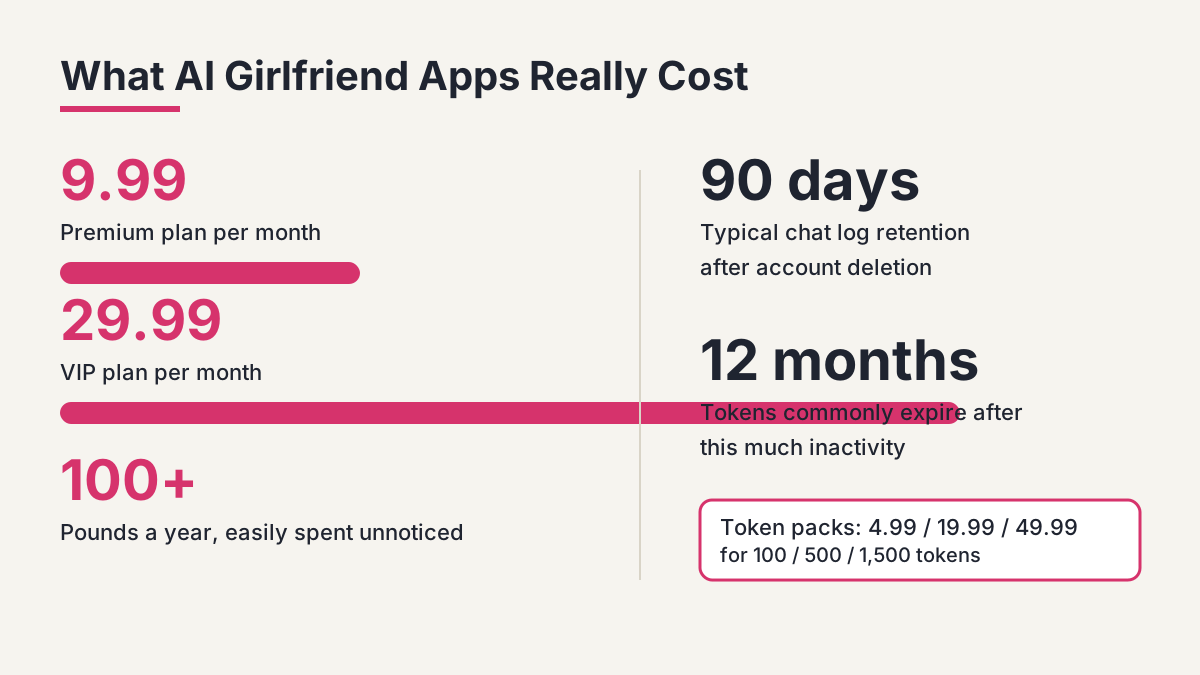
Most ranked lists of AI girlfriend apps reward whoever pays the affiliate commission. A better test is boring and practical: what does the app cost per month, what happens to your messages, and what does it do when the novelty fades? Premium plans in this category commonly start around 9.99 per month and climb to 29.99 for top tiers, so a UK user can easily spend over 100 pounds a year without noticing. This comparison sets out how to weigh the options, where each type of app falls short, and which choice fits which kind of person.
How the main app types differ
Apps in this space fall into three rough camps, and the camp matters more than the brand name. Subscription apps charge a flat monthly fee for unlimited text chat, with voice and images bundled into higher tiers. Token apps sell credits instead: roughly one token per text message, around five for a voice message and ten for a generated image. Hybrid apps mix both, with a free tier that is deliberately thin.
The pricing model shapes behaviour. A flat subscription rewards long, rambling chats, which suits people who simply want company in the evening. Tokens reward short, high-impact requests, and the meter running in the background changes how relaxed a conversation feels. Skip token apps if you are the type to chat for hours. Choose them if you only want an occasional image or voice note and would rather pay nothing in quiet months.
Free tiers deserve suspicion. They usually cap daily messages and lock voice and images, so a free trial tells you very little about the paid experience. Test the free version for tone and memory only, then judge the paid tier separately.
What each type costs in practice
Published tier prices across this category cluster in three bands: a basic plan with limited interactions, a premium plan near 9.99 per month, and a VIP plan near 29.99. Token packs follow the same logic, with figures such as 4.99 for 100 tokens, 19.99 for 500 and 49.99 for 1,500 appearing across the market. Tokens commonly expire after twelve months of inactivity, which matters if you buy a large pack and drift away.
The reality is that the headline price is rarely the real price. Billing disputes are the most frequent complaint in this sector, usually unexpected renewals or failed refunds. Before entering card details, find the cancellation page, check whether renewal happens automatically, and note the refund window. A reputable service states these terms plainly and lets you leave in a few clicks. If you cannot locate them in two minutes, that is your answer.
For context on a specific service, our Joi AI review walks through its plans in detail, and the Joi AI complaints page covers the billing and behaviour issues users raise most often.
Is the money worth it?
In November 2023 I put together a comparison for readers asking exactly this, whether an AI companion subscription represents value next to other digital wellness tools in the same bracket. At roughly 20 pounds a month, the category sits between meditation apps and casual therapy-adjacent platforms. The findings were clear on one point: users who treated the tool as a way to practise communication, rather than a stand-in for human contact, reported noticeably better outcomes. That framing also had a commercial effect. Platforms that market around that use case tend to attract people with realistic expectations, and those people cancel less often.
So the honest answer depends on what you want. If you want low-pressure conversation practice or a bit of evening company, a 10 pound plan is defensible. If you expect an emotional bond that feels real, you will probably be disappointed and keep paying anyway. Decide your purpose before you choose a plan, not after.
Privacy and data: what UK users should check
Your chats are intimate by design, so data handling is the biggest differentiator and the one lists ignore. Typical practice in this sector is encryption at rest and in transit, chat logs retained for around 90 days after account deletion, and anonymised analytics kept indefinitely. Some apps share aggregated data with research partners. None of this is unusual, but all of it should be written down in the privacy policy rather than implied.
UK users are covered by UK GDPR, which gives you rights to access, correct and delete your data. Use them. Request a data export from any app you try seriously, and see how long the reply takes. A slow or evasive response tells you more than a glossy privacy page. Never share financial details, your employer or your full address in chat, however natural the conversation feels, because logs can be reviewed by moderators.
Our guides on whether Joi AI is safe and whether Joi AI is legitimate apply these same checks to a single platform, so you can see the method in action.
Age verification and content filtering
Responsible apps verify age with a government ID and a selfie match, usually through a third-party checker, and delete the ID data afterwards while keeping only the verification status. Re-verification every twelve months is a good sign. Apps that accept a simple tick-box confirmation are cutting corners, and in the UK that gap matters more as online safety rules tighten.
Content filtering is the other half. Expect prompt scanning before generation and automated plus human review afterwards, with prohibited categories covering illegal activity, non-consensual themes and impersonation of real people. Filters are imperfect in both directions: some users report false positives that block harmless messages, others see rule-breaking content slip through. Look for an in-app report button and an appeal route, since both show that a human sits behind the system.
What could be better across the category
Repetition is the most common behavioural complaint. After a few weeks many AI companions loop through the same phrases, forget earlier details or drift out of character. Better apps let you reset or tune the personality, but none removes the problem entirely. Token expiry is the second irritation, because credits you paid for quietly vanish after twelve months without use.
Support speed is the third. Billing tickets often take days, and refunds, where valid, are typically promised within about seven days rather than granted instantly. Age verification can also stall for manual review. These are not reasons to avoid the whole category, but they are reasons to start on a monthly plan rather than an annual one.
Which app suits which person?
Someone who wants long, steady conversation should lean towards a flat-rate subscription service with good memory and a calm tone. Someone curious about voice and image features, and happy to ration them, is better served by a token model. A cautious first-timer should pick whichever app publishes clear data terms and a plain cancellation route, even if its chat feels slightly less polished.
One practical method works well. Spend a week on free tiers of two apps, note which one remembers details better, then pay for only one month of the winner. Set a reminder for day 25 to decide on renewal. That small habit protects you from the quiet drip of unwanted subscriptions, which is where this market makes much of its money.
The market also moves quickly, with features and prices changing between quarters, so treat any ranking, including ours, as a snapshot. Recheck pricing pages and terms before you commit, and keep notes on what you actually used.
Comments
No comments yet.
Leave a comment
Your email will not be shown. Comments are reviewed before they appear.