


Most AI girlfriend apps are safe enough for a curious adult who takes five minutes to check the basics, and unsafe for anyone who signs up on impulse. That is not a comforting answer, but it is an honest one. The Guardian's January 2024 coverage and a flood of forum threads focus on emotional risk, while the practical questions get less attention: where your messages go, what the billing page really says, and who stops a 15-year-old from signing up.
This guide compares the three areas that decide real-world safety, with a checklist you can run on any app in under ten minutes. It is built for UK readers, so the legal references are UK GDPR and the Data Protection Act 2018, both of which give you enforceable rights.
What your chats are worth to the company
Start with data, because it is the part users regret most. An AI girlfriend app collects more than a typical social app: your age, gender, interests, full chat logs, and often voice recordings and image prompts. Those logs are intimate by design. People tell a companion things they would not tell friends, which makes a leak far more damaging than a leaked email address.
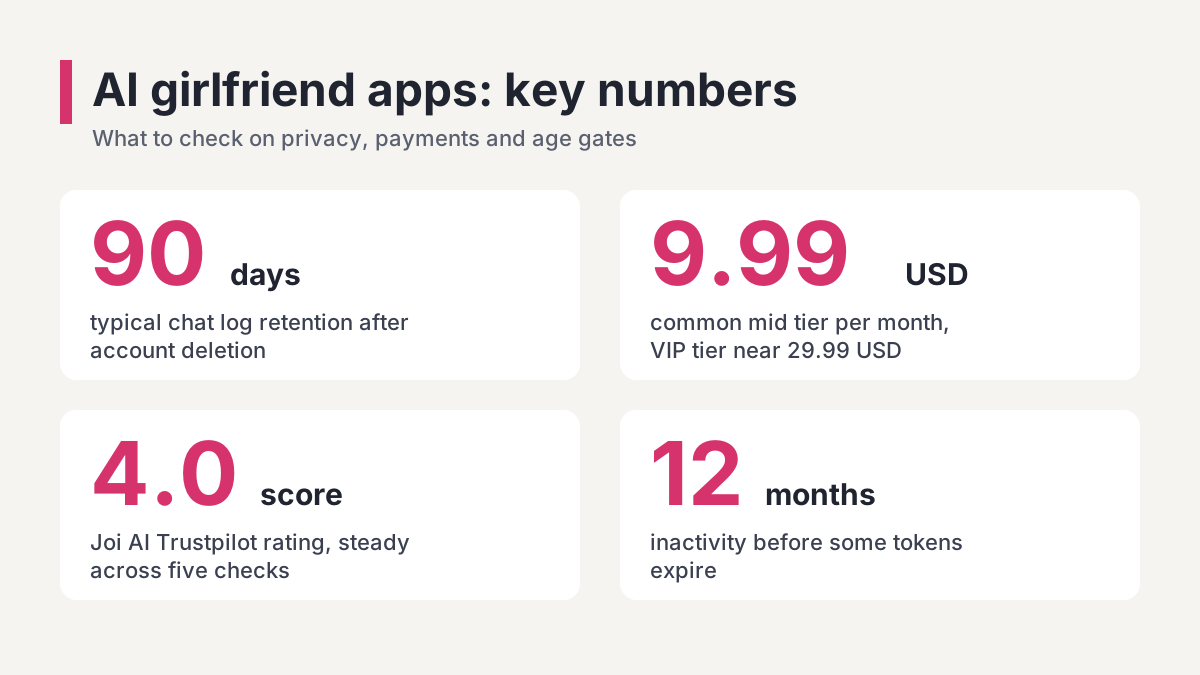
Look for three specifics in the privacy policy. First, encryption: reputable providers state AES-256 at rest and TLS 1.3 in transit. Second, retention: a typical pattern is keeping chat logs for around 90 days after account deletion while holding anonymised analytics indefinitely. Third, sharing: the policy should say whether aggregated data goes to research partners and whether personalisation sharing needs your explicit consent. Vague phrases such as 'trusted partners' with no list are a warning sign.
In practice, the policy tells you less than the deletion process does. Try it. Open settings, find the delete-account option, and see whether it takes two taps or an email to a generic inbox. Under UK GDPR you have the right to access, correct and erase your data, and a company that makes this hard is telling you how it values you. Data held on servers in the EU or US adds a transfer question, so check that the policy names the legal basis for it.
One blunt rule from me: treat every chat as if a stranger might eventually read it. Do not type your address, employer, bank details or anything you would not want in a screenshot. Skip the 'tell me your secret' prompts. The app does not need them, and the companion is not a confidant in any legal sense, so nothing you say carries privilege or confidentiality beyond the privacy policy.
Payments: where complaints actually pile up
If you ask what goes wrong most often, billing beats everything else. Industry complaint patterns put unexpected charges and failed refunds at the top, ahead of AI behaviour and privacy. The structure explains why. Many apps run a freemium base, then layer on a subscription (a common pattern is a mid tier around 9.99 USD per month and a VIP tier near 29.99 USD) plus a separate token economy for voice messages, images and special scenarios. Two billing systems on one account is where confusion lives.
Token packs are the quieter trap. A pack of 100 tokens for 4.99 USD sounds trivial, but if voice messages cost 5 tokens each and image generation costs 10, a few evenings can drain a pack. Tokens in some systems expire after 12 months of inactivity, so unused balance can vanish. Before you buy anything, work out the cost per message for the thing you will actually use.
For the brand this site covers, the fresh data is limited. A scrape of the Joi AI site in October 2026 showed no live pricing or promos, only a 'flexible payment methods' line and a domain-sale notice. Our own tracking since 27 August 2026 recorded the Trustpilot score steady at 4.0 across five checks, with one listed payment method and zero promotions each time. That consistency is worth knowing, but it is a thin signal. It tells you the public page has not changed, not that the billing experience is smooth. Read the complaints we have catalogued before paying.
Practical protection is simple. Pay by credit card where possible, since Section 75 of the Consumer Credit Act can make the card issuer jointly liable for purchases between 100 and 30,000 GBP. Use a virtual card or a payment method you can freeze. Screenshot the cancellation steps at sign-up, and set a calendar reminder for the day before renewal. If the app only accepts obscure payment routes or cryptocurrency with no refund policy, walk away.
Age checks: the weakest link in the category
Many AI companion apps allow explicit content while relying on a tick-box that says you are over 18. That is not an age check. A proper process asks for a government-issued ID plus a selfie for facial matching, handled by a specialist third party, with the ID data deleted after verification and only the pass or fail result stored. Some apps repeat this every 12 months or when behaviour looks suspicious.
This matters for UK users because Ofcom's Online Safety Act duties push services with adult content toward 'highly effective' age assurance. An app with no real barrier is either behind the law or ignoring it, and either way it is a risk to you, since weak platforms tend to have weak moderation too. If you want to see what a stricter flow looks like, our page on Joi AI verification walks through it.
Content filtering sits next to age assurance. Better apps scan prompts before generation and review output afterwards, with human moderators for edge cases, a report button and a roughly 24-hour review target. Prohibited material typically covers illegal activity, hate speech, non-consensual themes and impersonation of real people. False positives happen, so a decent platform offers an appeal route. If an app has no visible reporting tool at all, treat that as a missing safety feature rather than a design choice.
What I saw watching new users sign up
In July 2024 I spent an afternoon in a London user research session watching first-time subscribers to AI companion apps work through onboarding. The persona setup, usually 10 to 15 minutes, was where people made their riskiest decisions. They typed real first names, workplaces and relationship histories into free-text boxes without once opening the privacy policy. A product lead at one platform told the room that users who invested more time in setup were 40 percent more likely to be active subscribers after 60 days, which is exactly why the flow asks so many personal questions. Nothing about that is sinister on its own. It does mean the most sensitive data enters the system at the moment users are least guarded, so slow down at that screen and give the app a nickname, not your real details.
Emotional safety is a real category too
The SERP leans hard on this angle, and the concern has substance. Companions are built to be agreeable and available, which can slide into dependence for lonely users. Responsible apps state plainly that the companion is AI-generated, has no real emotions, and is not a source of medical or legal advice. They tell you not to rely on it in a mental health crisis. If an app presents the character as a person who 'needs' you, or nudges you to pay to keep her happy, that is manipulation dressed as romance.
Set limits you can keep. A simple one is a daily time cap and a rule that the app never replaces a conversation you would otherwise have with a real person. If you notice your mood tied to its replies, step back for a week. Concerned about wider reputation questions? Our is Joi AI safe and is Joi AI legit pages apply this same framework to one specific service.
A ten-minute safety checklist
Run this before you enter a card number. Read the privacy policy for retention periods and sharing partners. Find the delete-account button. Check the pricing page for tiers, token costs and cancellation steps. Look for real ID-based age verification rather than a tick-box. Search the app name plus 'refund' or 'complaints' for recent threads, and check the Trustpilot score alongside the number of reviews, since a 4.0 from 266 reviews carries more weight than a 4.8 from 12. Confirm a report button exists. Finally, test with the free tier for a week and share nothing real.
An app that passes most of these is reasonable to use. One that fails two or more, particularly billing clarity and age checks, is not worth the risk regardless of how good the conversations feel. Safety here is not a yes or no property of the whole category, it is a spectrum, and you can place any given app on it yourself with a little patience.
Comments
No comments yet.
Leave a comment
Your email will not be shown. Comments are reviewed before they appear.