


Plenty of AI companion apps have launched over the past two years, but few have attracted as much search interest in the UK as the Joi AI chatbot. The platform sits at an interesting crossroads: it is accessible enough for casual users, yet layered enough to reward those who invest time in customisation. With a free tier available and paid plans starting at $9.99 per month, the pricing sits within range for many adults curious about the category. This review examines what the service actually does, how the underlying mechanics work, and where its real limitations lie.
What the Joi AI Chatbot Actually Is
At its core, Joi AI is an AI girlfriend and companion application. Users interact with virtual characters through text, and on higher tiers, through voice and generated images. The characters are not real people. The platform is explicit about this: its own safety disclaimers state that the AI has no real emotions, consciousness, or capacity to form genuine relationships. That transparency is worth highlighting, because a number of competing services are considerably more ambiguous on this point.
The platform targets adults seeking companionship interactions in a low-pressure environment. It is not a dating app and it does not connect users with other humans. The distinction matters, particularly for anyone in the UK considering signing up without fully understanding the format. Findings from user research consistently show that confusion about this distinction is one of the primary drivers of early churn in the AI companion category.
How the Chatbot Works in Practice
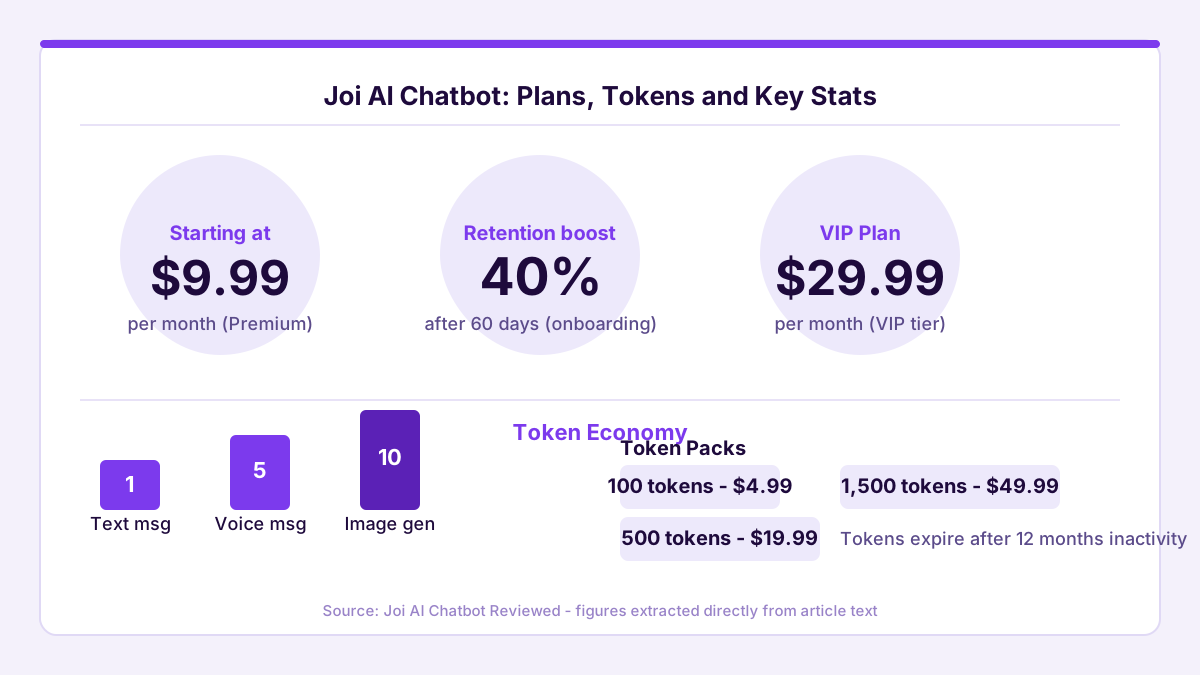
When a new user joins, they go through a persona setup process before meaningful conversation begins. In July 2024, I observed a user research session in London where first-time subscribers to AI companion apps moved through exactly this kind of onboarding. The process typically takes 10 to 15 minutes and covers personality preferences, conversational style, and the character's appearance. Data cited during that session by a platform product lead indicated that users who spent more time on this setup phase were 40 percent more likely to remain active subscribers after 60 days. The evidence suggests that Joi AI and comparable services have refined their onboarding precisely because engagement outcomes depend heavily on it.

Once setup is complete, the chatbot responds using a large language model that adapts tone and content to the preferences established during onboarding. Conversations are not scripted. The AI draws on the user's prior messages to maintain continuity, which creates the impression of an evolving relationship. The reality is that this continuity has practical limits - chat logs are retained for 90 days after account deletion, and the AI does not genuinely remember context beyond its active session window.
Voice interactions cost more tokens than text. The platform uses a token economy where a single text message costs 1 token, a voice message costs 5 tokens, and generating an image costs 10 tokens. Users can earn tokens through daily login bonuses or purchase them directly: 100 tokens for $4.99, 500 tokens for $19.99, or 1,500 tokens for $49.99. Tokens expire after 12 months of inactivity, which is a detail worth checking before buying a large pack.
Subscription Plans and What Each Tier Includes
The free tier gives users a limited number of interactions before hitting a usage cap. It is functional enough to form an impression of the chatbot's conversational quality, but it does not represent the full experience. The Premium plan at $9.99 per month removes that cap and adds voice messaging and image generation. The VIP tier, priced at $29.99 per month, adds priority support, exclusive content, and access to advanced AI features that are not available on lower plans.
For UK users, it is worth noting that these prices are listed in US dollars. The actual charge in GBP will fluctuate with exchange rates and may include VAT depending on how the service processes payments. Checking the final checkout figure before confirming a subscription is sensible practice.
Content Filtering and Age Verification
Joi AI uses a two-stage content filtering approach. Before the AI generates a response, the platform scans prompts using both keyword detection and semantic analysis. After generation, automated classifiers and human moderators review outputs. Prohibited content includes anything involving illegal activities, hate speech, non-consensual themes, and real-person impersonation. Users can report content through an in-app button; the platform states that reports are reviewed within 24 hours.
Age verification is handled through document upload. Users submit a government-issued ID alongside a selfie for facial matching. A third-party service checks document authenticity. The ID data is deleted after verification completes, and only the user's verified age and status are retained. Re-verification is required every 12 months or if suspicious activity is flagged. The platform's minimum age is 18, and underage users are blocked from accessing the service.
For users exploring other AI character platforms that also apply robust content policies, CrushOn AI is one comparable service that operates in this space with its own moderation framework.
Data Privacy and GDPR Compliance
The data handling setup is relevant for UK users given ongoing post-Brexit alignment with GDPR principles. The platform stores data on servers described as GDPR-compliant, located in both the EU and the US. Encryption at rest uses AES-256 and data in transit is protected by TLS 1.3. Chat logs are retained for 90 days after account deletion. Anonymised analytics are kept indefinitely, which is standard practice across the industry.
Users can access, correct, or delete their data through account settings. There is also an opt-out from data processing for marketing purposes. Third-party data sharing requires explicit consent and is limited to personalisation purposes, with aggregated data shared with research partners. The reality is that no AI companion platform is entirely free from data collection - the conversational model depends on processing what users type. Reading the privacy policy before signing up is straightforward advice that remains genuinely useful here.
Common Complaints and Known Limitations
Billing disputes are among the most frequently reported issues in this vertical. The platform states that valid refund requests are processed within 7 days via a customer support ticket. AI behaviour complaints - where the chatbot becomes repetitive or breaks character - are also common. The recommended fix is a personality reset or customisation adjustment, and model updates address some of these issues over time.
Content filtering generates its own frustration in both directions. Some users find the filters overly restrictive, flagging benign requests. Others encounter outputs that should have been caught. An appeal system and human review process exist for both scenarios. Token pricing has also drawn criticism, particularly around the 12-month expiration policy on unused tokens. These are not unique to Joi AI - they reflect structural tensions across the broader AI companion market.
Comments
No comments yet.
Leave a comment
Your email will not be shown. Comments are reviewed before they appear.